
PCG Academia Joins the DSpace North American User Group Meeting for the First Time
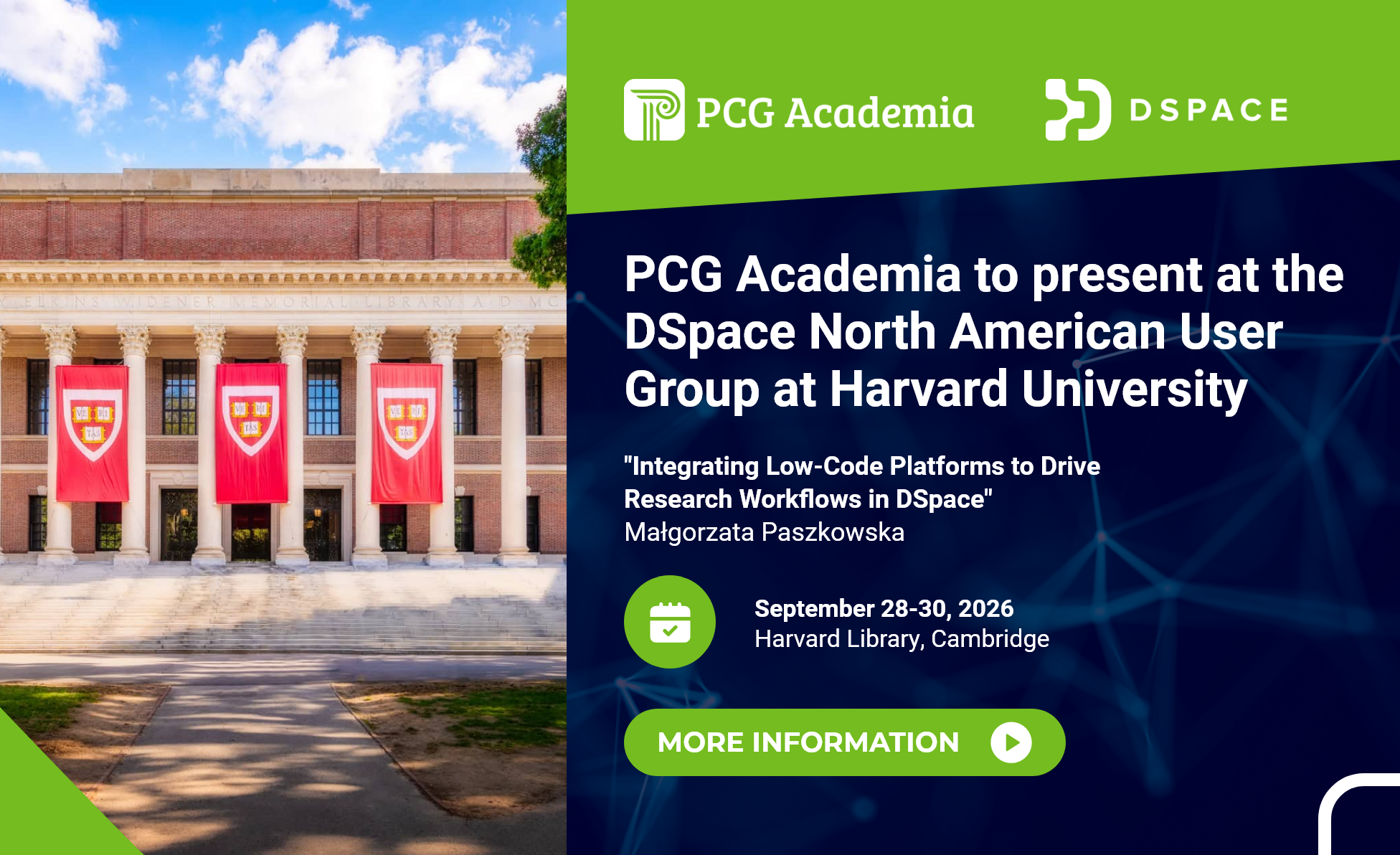
24 July 2026 4 min readingWe are pleased to share that PCG Academia will take part in the DSpace North American User Group Meeting for the first time. This year’s meeting takes place September 28–30, 2026, in the Lamont Forum Room at Harvard University in Cambridge, Massachusetts.
The event is organized by the DSpace North American User Group in cooperation with LYRASIS and Harvard Library Open Scholarship and Research Data Services. It brings together the people who run and support DSpace across the region: repository managers and administrators, developers and technical staff and service providers.
Our proposal was selected for the program
We are honored that our submission was selected by the team at Harvard Library Open Scholarship and Research Data Services and included in the conference program. Małgorzata Paszkowska will present “DSpace as a Living Repository: Integrating Low-Code Platforms to Drive Research Workflows” on Monday, September 28.
What we will be talking about
Most institutions treat DSpace as a destination, a place where finished work is deposited after the fact. Our presentation makes the case for a different model: DSpace as a living data backbone, actively integrated with a low-code workflow platform to drive day-to-day research operations.
We will walk through a practical implementation built around two use cases.
Case 1) Faculty performance review. DSpace serves as the authoritative source of record. Rather than re-entering publications and project outputs by hand, the low-code platform queries DSpace via API and pre-populates evaluation forms with verified bibliographic records. The approval workflow (faculty member, department chair, Vice Provost for Research) is configured directly in the low-code environment, with automated notifications and resubmission at each stage.
Case 2) Research project management. Projects are created and managed entirely within the low-code platform: team composition, task tracking, budget monitoring and deliverable registration. Here DSpace is not just a deposit target but a data source. Researcher profiles and equipment records held in DSpace feed directly into project setup, eliminating redundant data entry. When a project reaches a defined milestone, the platform automatically triggers a deposit to DSpace, pre-filled with metadata generated throughout the project lifecycle. The integration layer can extend further to HR and ERP systems, making DSpace a hub in a broader institutional data ecosystem.
The integration is built on the DSpace REST API, configured through the low-code platform’s native API capabilities and our team’s hands-on knowledge of the DSpace data model. No middleware products. The effort went into the things that actually matter: metadata mapping, workflow design, and permission modeling.
Attendees will leave with a clear architecture pattern, a practical metadata mapping framework, and honest lessons learned, including what to plan for before you start.
A different vantage point on DSpace
The DSpace North American User Group Meeting program is rich and covers a lot of ground the community has been working on: configurable Entities, ORCID and persistent identifiers, the DSpace and DSpace-CRIS merger, cloud-native deployment, usage statistics, content accessibility, and bitstream persistence. Much of that work looks inward, at the repository itself and it is exactly the kind of work that keeps the platform healthy.
We have come to see DSpace slightly differently: less as an archive that sits at the end of a process, and more as one component in a living institutional ecosystem, connected to the systems people actually work in every day. That view is what our presentation is really about, which is why it approaches DSpace from a different direction than most of the program: not the repository itself, but the institutional processes around it, such as faculty evaluation, project management, and connections to HR and ERP systems. We also bring a perspective from outside North America and a low-code approach that does not come up often in this setting. Both views are needed, and we are curious how ours lands with people solving similar problems in different contexts.
We look forward to the conversations in Cambridge. Full program details and registration are available on the:


