
DSpace AI Search & Accessibility

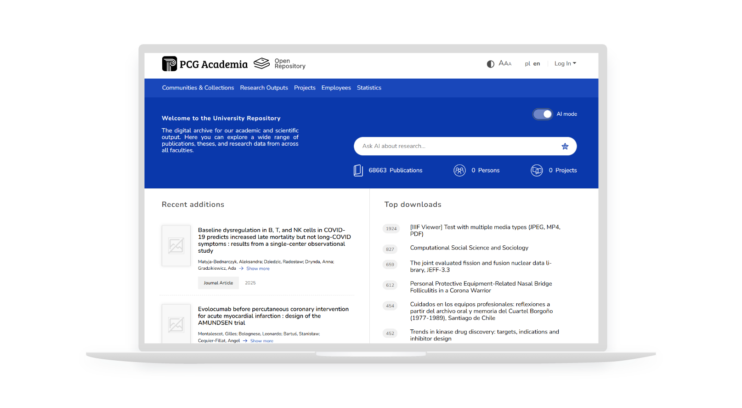

DSpace AI Search & Accessibility
Intelligent search and accessibility of research resources powered by AI
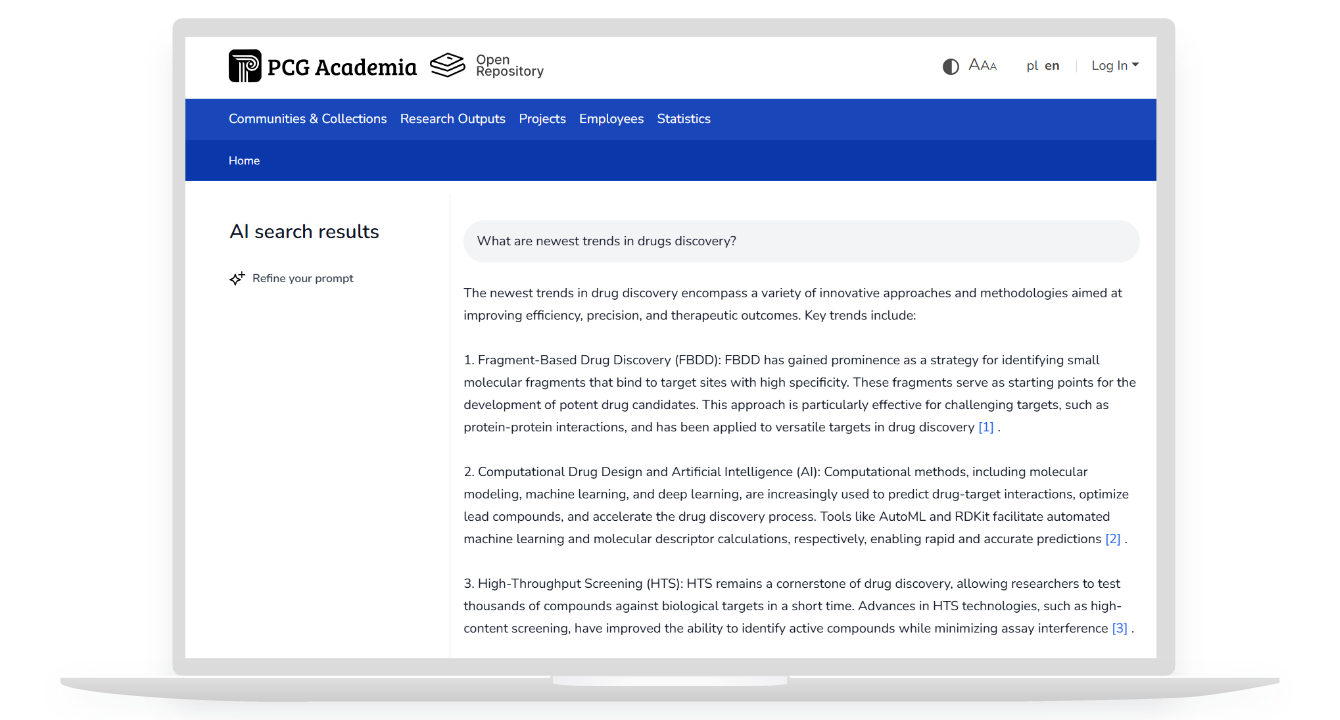
How does artificial intelligence take DSpace to the next level?
DSpace holds a vast body of research output but without the support of modern AI-powered tools, it can remain a data aggregation system that requires users to already know what it contains in order to find the answers they are looking for. AI Search & AI Accessibility changes this entirely.
These tools transform DSpace from a repository into a modern knowledge discovery engine – built on semantic search that understands the meaning of content, not just keywords. At the same time, they make the knowledge held in the repository genuinely accessible to all users, including those working with older, static PDF files. This is not an upgrade – it is a new dimension of what DSpace can be for a university. DSpace truly reimagined.
Key benefits

DSpace as a tool for exploration and knowledge discovery — not just a publication archive
Significantly higher search relevance — the system understands intent, not just keywords
Greater visibility, use and citability of the university’s research output
Digital accessibility as an integral and automatic part of every publication in the repository
Scalable handling of resources without costly, manual document processing
Implementation delivered by PCG Academia — DSpace Platinum Service Provider — guaranteeing the highest service standards and years of experience in the academic environment

Key features

AI Search
semantic search based on text embeddings and vector databases — the system understands the meaning of a query and the context of content, not just keyword matching
AI Accessibility for PDF
automatic conversion of documents to WCAG-compliant formats, covering both new publications and archival repository resources
Advanced OCR and structuring
text recognition from scans, layout analysis, semantic tagging and content organisation — with the ability to review and control results
Relationship discovery
automatic linking of publications, research data, reports and theses into a coherent knowledge network
Discovery across the repository structure
exploration of content across collections, formats and repository structure — users find what they are looking for regardless of where it was deposited
How does it fit into the university ecosystem?

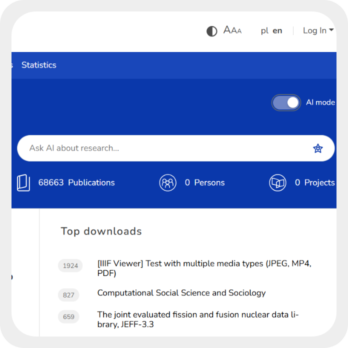
Native integration with DSpace — works directly on existing resources with no need to rebuild the repository or manually tag content
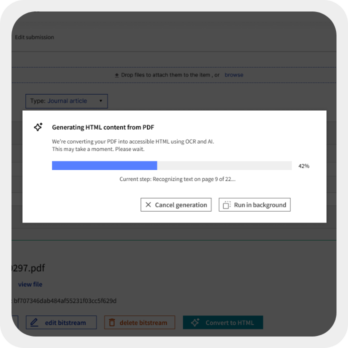
Supports both new publications and legacy PDF archives — AI retrospectively processes the entire repository
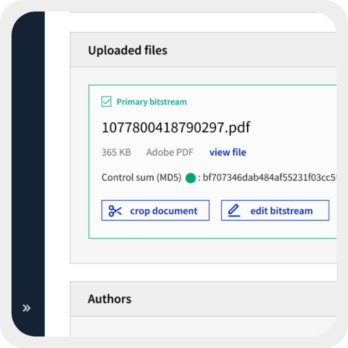
Data prepared for further use by:
- CRIS systems
- Analytics and reporting
- Further AI tools (summarisation, information extraction, recommendations)

A scalable solution ready to deploy in your existing DSpace
Proven approach, real results
A solution that simultaneously increases the impact of research and meets digital accessibility requirements — without placing additional burden on your team.

Significantly higher search relevance and faster access to valuable content for users

Greater repository usage — more downloads, data reuse and increased citations

Scalable digital accessibility without costly manual document processing — with automatic compliance with institutional and regulatory accessibility policies, including WCAG

A better experience for users relying on screen readers, working on mobile devices, or exploring interdisciplinary resources

Technology and implementation model
AI Semantic Search based on:
- text embeddings
- vector databases
- RAG (Retrieval-Augmented Generation) with full source transparency

AI Accessibility:
- advanced OCR and layout analysis
- semantic tagging and content organization
- generation of alternative descriptions (alt-text) with control options

A scalable solution ready to deploy in your existing DSpace
Next steps
👉 See how AI Search & Accessibility transforms DSpace into a knowledge discovery engine

Presentation on the university’s actual collections

Discussion of the implementation scenario and business outcomes

Consultation in the context of science visibility and digital accessibility
Discover all our products
- WEBCON
- Education
- DSpace
-
WEBCON Finance and HR

Process and integration platform for finance and HR in higher education.
Learn More -
WEBCON for Education
Digital Student Folder and the study administration process in a low-code model.
Learn More -
WEBCON for Science
Low-code for research management, powered by data from CRIS systems and repositories
Learn More



-
Anthology Ally
A tool that enhances digital accessibility and supports inclusive teaching
Learn More -
Panopto
A platform leveraging AI for video content, combining creation, storage, and smart management of academic recordings in one place
Learn More




-
DSpace CRIS
The most mature form of research management — from repository to a full Current Research Information System
Learn More -
DSpace AI Search & Accessibility
Intelligent search and accessibility of research resources powered by AI
Learn More




Contact us to schedule a DEMO
Fill out the contact form


