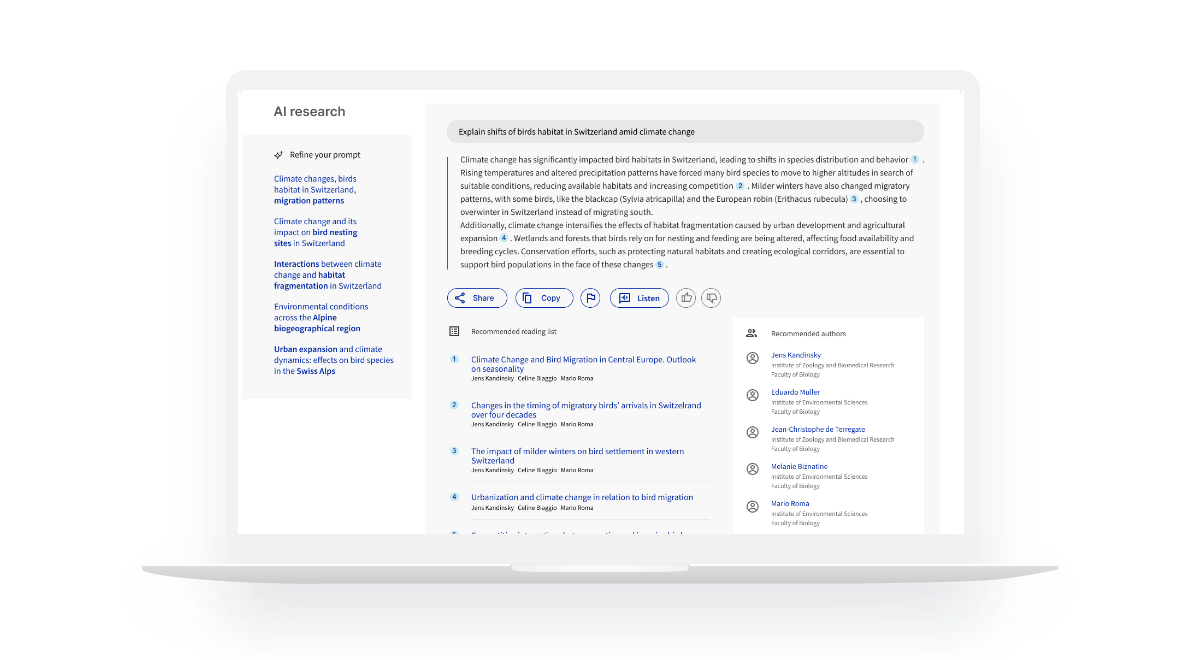
Semantic encoding: the system transforms documents and queries into vector embeddings that capture underlying meaning rather than exact wording.
Targeted retrieval a vector index identifies the closest semantic matches, ensuring the system returns content that truly aligns with the user’s intent.
Generative reasoning: the retrieved passages guide the model as it produces responses grounded in the repository’s content, resulting in accurate, coherent, context-aware answers.
Is your researcher overwhelmed by the volume of institutional content and struggling to find relevant, cross-disciplinary works using keyword searches?
AI search uses meaning-based retrieval to surface related literature, datasets and methods rather than relying solely on keyword matches. It can extract experiment details and produce concise summaries, with direct links to the underlying repository items and supporting data. This speeds literature reviews and helps researchers discover novel connections more efficiently.
Student
Is your student overwhelmed by the volume of institutional content and struggling to find relevant, cross-disciplinary materials using keyword searches?
AI search uses meaning-based retrieval to surface related readings, datasets and study methods rather than relying solely on keyword matches. It can extract key findings, assignment-relevant details and produce concise summaries, with direct links to the underlying repository items and supporting data. This speeds literature reviews and helps students discover novel connections and prepare coursework more efficiently.
Discover all PCG products
DSpace
E-learning
Low-code
DSpace CRIS
DSpace CRIS is an enhanced version of DSpace, designed for research institutions that require more than just a traditional publication repository. DSpace CRIS is more than a repository –it is a holistic information system connecting researchers, institutions, projects, grants, and citation metrics, providing a comprehensive view of research impact and collaboration.
Conventional keyword search misses context and relationships. AI semantic search tool from PCG Academia understands meaning, not just keywords, linking concepts, datasets and papers even when phrasing differs.
Many scholarly PDFs remain locked in static layouts that hinder readability, searchability and access for users with disabilities. AI-driven conversion tool from PCG Academia automates tagging, OCR correction and semantic structuring to produce interactive documents that work with screen readers.
Information about personal data controllers can be found in the GDPR tab at https://pcgacademia.pl/gdpr/. We kindly ask you to read this information with due attention.
Niniejsza strona wykorzystuje pliki cookies na zasadach określonych w polityce prywatności. Jeśli nie wyrażasz na to zgody, prosimy o wyłączenie obsługi cookies w przeglądarce lub opuszczenie serwisu. Więcej informacji